
Azure Resource Groups are one of the first concepts every AZ-900 student needs to lock in before moving on to the rest of the Microsoft Azure Fundamentals syllabus. They appear early in the exam, they underpin almost every other topic that follows from role-based access control to cost management and they are one of the most commonly misunderstood ideas by first-time cloud learners.
This guide breaks down exactly what an Azure Resource Group is, why it matters so much for the AZ-900 exam, how it fits into the broader Azure hierarchy, and the kind of exam questions you can expect to see on the topic.
What Is an Azure Resource Group? (AZ-900 Definition)
In simple terms, a resource group is a logical container that holds related Azure resources virtual machines, storage accounts, databases, and networking components that share the same lifecycle. Rather than managing dozens of individual resources one at a time, Azure lets you group them together so you can deploy, monitor, secure, and delete them as a single unit.
For the AZ-900 exam, the key phrase to remember is this: a resource group is a container used to manage and organise related Azure resources, and every resource must belong to exactly one resource group. Microsoft’s own Azure Resource Manager documentation is a useful reference to bookmark alongside your AZ-900 study notes.
Why Resource Groups Matter for the AZ-900 Exam
Resource groups sit right at the centre of Microsoft’s “Describe core Azure architectural components” exam domain, one of the highest-weighted sections of the AZ-900 syllabus. Examiners frequently test whether candidates understand that:
- A resource can only belong to one resource group at a time.
- Resources within a group can span multiple Azure regions.
- Deleting a resource group deletes every resource inside it.
- Access control (RBAC) and cost tracking can both be applied at the resource group level.
Getting comfortable with these four points alone will resolve the majority of resource-group questions you’ll face on exam day.
Azure Resource Groups vs Subscriptions vs Management Groups
One of the most common points of confusion for AZ-900 students is how resource groups fit into Azure’s broader management hierarchy. The table below lays out the full structure, from the top level down:
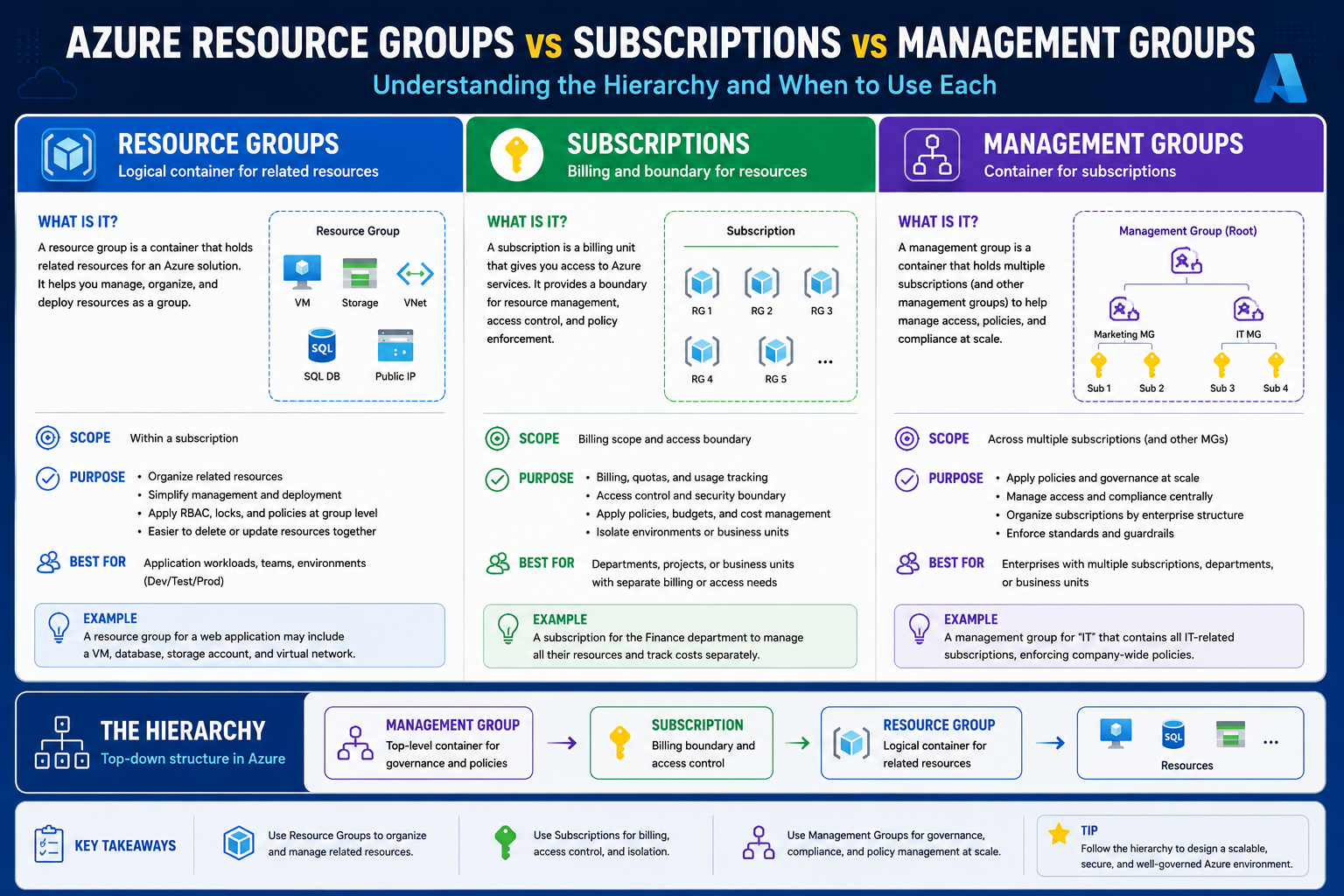
| Level | What It Does | Example |
| Management Group | Groups multiple subscriptions for organisation-wide governance and policy | A company grouping all its Australian subsidiaries’ subscriptions |
| Subscription | A billing and access boundary that contains resource groups | “Production” or “Development” subscription |
| Resource Group | A logical container for related resources sharing a lifecycle | “WebApp-Prod-RG” holding a web app, database, and storage account |
| Resource | The individual Azure service instance itself | A single virtual machine or storage account |
Key Rules and Features of Azure Resource Groups
Resource Group Naming and Region
A resource group has its own name and region, but the region you assign to the group only stores its metadata the resources inside it can still be deployed to entirely different regions. This is a frequent AZ-900 trick question, so remember: the resource group’s region is not necessarily where its resources physically live.
Access Control (RBAC) at Resource Group Level
Azure role-based access control can be applied directly at the resource group level, meaning every resource inside automatically inherits those permissions. This is far more efficient than assigning access resource-by-resource and is a core reason organisations structure their environments around well-planned resource groups.
Deleting a Resource Group
Deleting a resource group permanently deletes every resource contained within it. There is no separate step required this cascading behaviour is exactly why Microsoft tests it so often, since it’s a real-world safeguard candidates need to understand before working in a live environment.
Moving Resources Between Groups
Most Azure resources can be moved between resource groups, and even between subscriptions, without being recreated from scratch. Some resource types have restrictions on cross-region or cross-subscription moves, which is worth knowing conceptually even though AZ-900 rarely tests the finer exceptions.
Real-World Example: Organising Resources Into Groups
Picture a small Australian business running a customer-facing web application. A well-structured Azure environment might organise resources as follows:
- WebApp-Prod-RG — the production web app, its database, and CDN
- WebApp-Dev-RG — a separate development and testing environment
- Networking-RG — shared virtual networks and firewalls used by both environments
Structuring resources this way means the development team can be granted access only to WebApp-Dev-RG, production costs can be tracked separately from development costs, and an entire test environment can be torn down safely by deleting a single resource group.
Common AZ-900 Exam Questions About Resource Groups
Q: Can a resource belong to more than one resource group at the same time?
No — every resource belongs to exactly one resource group.
Q: What happens to the resources inside a resource group if the group is deleted?
They are all deleted along with the group.
Q: Must every resource in a group be deployed to the same region as the group?
No — the group’s region stores metadata only; resources can be deployed to any region.
Q: What is the main purpose of a resource group?
To act as a logical container for managing, securing, and billing related resources as a single unit.
Where to Learn Azure Resource Groups: AZ-900 Training Across Australia
Understanding resource groups conceptually is one thing working through real exam-style scenarios with an instructor is what turns theory into exam confidence. Logitrain delivers instructor-led AZ-900 training in the following Australian cities:
| City | AZ-900 Training Availability |
| Sydney | Instructor-led classroom and live online AZ-900 sessions |
| Melbourne | Regular AZ-900 intakes with hands-on resource group labs |
| Brisbane | Live online and in-person AZ-900 training available |
| Perth | Flexible scheduling for Perth-based IT professionals |
| Adelaide | AZ-900 fundamentals training with exam-prep support |
| Canberra | Popular with government and public-sector cloud teams |
How Logitrain AZ-900 Course Helps You Master Resource Groups
Our AZ-900 Microsoft Azure Fundamentals course walks through resource groups with hands-on labs, not just slides — you’ll create, secure, and delete resource groups yourself so the concept sticks well before exam day. For learners planning a longer Azure career pathway beyond AZ-900, Logitrain’s full certification catalogue covers the next-step Azure Administrator (AZ-104) and Azure Developer (AZ-204) courses that build directly on resource group fundamentals.
Students who want a broader IT skills foundation alongside Azure can also explore Logitrain wider IT training catalogue, covering everything from networking to project management. [Usman: please confirm final course URL before publishing]
Frequently Asked Questions
Is Azure Resource Groups a heavily tested topic on the AZ-900 exam?
Yes. Resource groups fall under the architectural components domain, one of the largest sections of the AZ-900 exam, and questions on the topic are common and generally considered scoring opportunities once the concept is understood.
Do I need hands-on Azure experience to understand resource groups?
No prior experience is required the AZ-900 exam is designed for beginners, and most students grasp resource groups quickly once they see the concept demonstrated in a real Azure portal walkthrough.
How is a resource group different from a subscription?
A subscription is the billing and access boundary that can contain many resource groups, while a resource group is the smaller logical container that organises related resources sharing the same lifecycle.
Ready to master Azure Resource Groups and the rest of the AZ-900 syllabus? Enrol in our next AZ-900 course.